

Every UPI app runs on the same network, so the useful comparison is capability rather than brand. UPI Lite caps at Rs 1,000 a payment and Rs 5,000 held. Autopay runs unattended up to Rs 15,000, or Rs 1,00,000 for insurance, mutual funds and card bills. A credit line on UPI is borrowing, not paying.
Which are the best UPI apps in India
Asking which UPI app is best assumes the apps differ in what they do. For the core job they do not. Every one of them submits the same instruction to the same network, which routes it to the same banks under the same rules, and the protections that matter to you are set by those rules rather than by the app’s design.
What does vary is which capabilities an app has switched on for you, which bank account it is pointed at, and which extras sit around the payment. Those are worth comparing. Interface preference is real but it is a matter of taste, and taste is not what this page can settle. For the head-to-head between the largest apps, what genuinely differs between the three largest apps sets out what can and cannot differ between them.
So the question this page answers is different. Not which app, but which capability you actually need, and what each one caps.
The capabilities, and what each one caps
These are five distinct things an app can offer, each governed by its own rule and its own ceiling.
| Capability | What it does | The cap | Authentication |
|---|---|---|---|
| Standard UPI payment | Moves money from your bank account to another account | Set by your bank and the network, and varies by category | UPI PIN on every payment |
| UPI Lite | Small payments from a pre-loaded balance | Rs 1,000 per payment, Rs 5,000 held at any point | None on the payment. Authentication is needed to top up |
| UPI Autopay | Recurring payments that run without you | Rs 15,000 per debit, or Rs 1,00,000 for insurance premiums, mutual fund subscriptions and credit card bills | Once at setup. Above the cap, each debit needs you again |
| Credit line on UPI | Pays from a pre-sanctioned bank credit line rather than your balance | The credit limit your bank sets | UPI PIN, same as a normal payment |
| RuPay credit card on UPI | Pays from a credit card through a UPI QR code | Your card limit | UPI PIN, same as a normal payment |
The pattern worth noticing is in the last two rows. The authentication is identical to a normal payment, so the act of paying feels the same, while the money is coming from somewhere entirely different. That is the single most consequential thing to understand about the modern UPI app, and it is the subject of a later section.
UPI Lite: small payments without a PIN
UPI Lite exists because entering a PIN for a Rs 40 payment is friction out of proportion to the risk. It works by holding a small balance on the device.
The ceilings come from the Reserve Bank’s Framework for Facilitating Small Value Digital Payments in Offline Mode. The general rule is Rs 500 per transaction with Rs 2,000 outstanding on the instrument at any point. For UPI Lite the enhanced limits are Rs 1,000 per transaction and Rs 5,000 as the total. Offline payment transactions may be offered without additional factor of authentication, but replenishment of the used limit is allowed only in online mode with authentication, which is where the PIN returns.
The practical sizing is straightforward. Someone making four payments a day of about Rs 120 is spending Rs 480 a day through this route, so a Rs 5,000 balance lasts about ten days and covers roughly 120 small payments a month without a single PIN entry. Someone making three payments a day of about Rs 250 runs through the same balance in under a week.
The framework also preserves your protections. Balances held this way are covered under the Reserve Bank’s limited customer liability provisions, and customers have recourse to the Ombudsman scheme. You are trading the PIN prompt for a small stored balance, not trading away your position if something goes wrong.
UPI Autopay: paying without being there
Autopay is the UPI form of an e-mandate. The Reserve Bank extended the e-mandate framework to UPI in January 2020, applying all the conditions of the card framework mutatis mutandis, so a UPI Autopay mandate carries the same obligations an issuer owes on a card mandate.
The threshold that decides whether a debit runs on its own was raised in December 2023.
| What is being paid | Runs without you up to | Above that |
|---|---|---|
| Most recurring payments | Rs 15,000 per debit | Each debit needs authentication from you |
| Insurance premiums | Rs 1,00,000 per debit | Each debit needs authentication from you |
| Mutual fund subscriptions | Rs 1,00,000 per debit | Each debit needs authentication from you |
| Credit card bill payments | Rs 1,00,000 per debit | Each debit needs authentication from you |
| Setting up, changing or cancelling a mandate | Never runs without you | Always needs authentication |
The Authentication mechanisms for digital payment transactions Directions, 2025 confirm the underlying logic by listing recurring transactions under the e-mandate framework, other than the first, among the exemptions from the requirement that every digital payment be authenticated by two distinct factors. Compliance with those directions is required by 1 April 2026.
The consequence people get caught by is the one above the line. A Rs 22,000 rent mandate does not run on its own, so if you miss the authentication prompt the payment simply does not happen, whereas a Rs 90,000 card bill on autopay goes through unattended. For a large premium, paying a large premium through UPI covers the same ground from the insurance side.
Paying with credit, and why it is not paying
Two capabilities put borrowed money behind a UPI QR code, and both feel exactly like spending your own.
The Reserve Bank’s circular on the Operation of Pre-Sanctioned Credit Lines at Banks through UPI permits payments through a pre-sanctioned credit line issued by a scheduled commercial bank to an individual, with the prior consent of that individual, for transactions using the UPI system. Banks set their own terms, which may include the credit limit, the period of credit and the rate of interest. The separate linking a RuPay credit card to UPI route does the same thing through a card you already hold.
The important point is behavioural rather than regulatory. Nothing in the payment experience tells you which source you just drew on. The PIN is the same, the confirmation is the same, the speed is the same. What differs is that one debits a balance you own and the other opens a position you have to clear, and small everyday payments are precisely the kind that accumulate without anyone deciding to borrow. Before switching either on, it is worth reading what a credit line on UPI costs when it is not cleared in full.
What you are owed when a payment fails
This is the part of the comparison no app markets, and it is identical across all of them because it comes from the rules rather than the product.
The Reserve Bank’s turn around time circular requires that where an account is debited but the beneficiary account is not credited, the beneficiary bank effects an auto reversal latest on T plus one day, with compensation of Rs 100 per day if the delay is beyond that. Where the account is debited but the transaction confirmation is not received at the merchant location, auto reversal is required within T plus five days, with the same compensation after. And wherever financial compensation is involved, it shall be effected to the customer’s account suo moto, without waiting for a complaint or claim from the customer.
Read that last clause again, because it is the one that is routinely not honoured. The money is owed whether or not you ask.
| What happened | Reversal due by | Compensation if later |
|---|---|---|
| Rs 24,000 debited, beneficiary not credited, reversed on day 9 | T plus 1 day | 8 days late, Rs 800 |
| Rs 6,500 debited, beneficiary not credited, reversed on day 14 | T plus 1 day | 13 days late, Rs 1,300 |
| Merchant confirmation not received, reversed on day 8 | T plus 5 days | 3 days late, Rs 300 |
These are illustrative cases showing how the figure is arrived at, not a quote on any particular dispute. The amount of the original payment does not affect the compensation, which is a flat Rs 100 for each day of delay. For the full sequence of what to do while a reversal is outstanding, a payment that failed after the money left your account sets it out.
If the reversal or the compensation does not arrive, complain to the bank in writing and keep the reference. The Reserve Bank Integrated Ombudsman Scheme sits above that step and treats any deficiency in service as a valid ground.
Where everyday payments have been running on credit through UPI for a while, the balance behind them behaves like any other revolving balance and costs the same. BillCut converts high interest credit card balances into a single structured EMI at a lower rate with a fixed end date. That is worth looking at only if such a balance has accumulated, and it has no bearing on which capability you switch on.
Which app choice actually matters
Three things about the app are worth checking, and none of them is the interface.
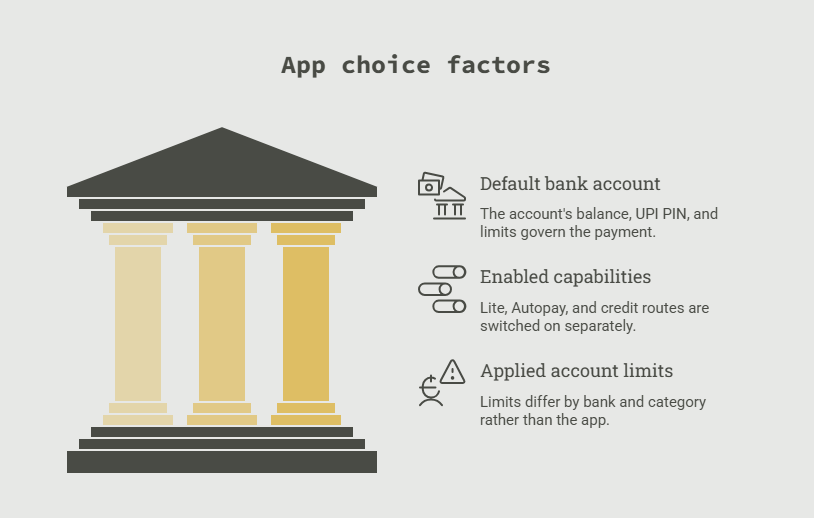
The first is which bank account it has selected by default, because that account’s balance, its UPI PIN and its own limits are what govern the payment. The second is which capabilities it has enabled for you, since Lite, Autopay and credit routes are switched on separately and an app that does not offer one is not a limitation of UPI. The third is the limits actually applied to your account, which differ by bank and by category rather than being a property of the app.
On that last point, published figures vary by app. The National Payments Corporation of India states for its 123PAY service, the feature phone route, a per transaction limit of Rs 5,000 and a daily limit of Rs 1,00,000. the Corporation’s own BHIM app states a limit of Rs 40,000 per transaction and Rs 40,000 per day for one bank account, with a maximum of ten financial transactions a day, and Rs 5,000 for a new user in the first 24 hours. Two services on the same network, different ceilings. The only reliable figure is the one in your own app against your own account.
Which capability fits which need
| If this is your situation | The capability to look at | What to watch |
|---|---|---|
| Many small payments a day, tired of the PIN | UPI Lite | The Rs 5,000 ceiling means topping up every week or two |
| A fixed monthly payment you keep forgetting | UPI Autopay | Above Rs 15,000 outside the three higher categories, it will not run on its own |
| A large one-off payment | Standard UPI, after checking the limit on that account | Limits differ by bank and by category, so check before the deadline, not on it |
| Short of balance before payday | A credit line on UPI, with care | It is borrowing. The payment experience will not remind you of that |
| Wanting card rewards on everyday spending | A RuPay credit card on UPI | Everyday payments become a card balance, which behaves like any other card balance |
Who should turn these on, and who should not
Worth enabling: UPI Lite if your day is full of small payments and the PIN prompt is the friction, since the ceiling caps the exposure anyway. Autopay if the payment is fixed, predictable and you are reading the pre-debit notifications. A second bank account in the same app if you want a fallback when one is blocked or short.
Worth leaving off: credit on UPI, whether through a credit line or a card, if you already carry a revolving balance, because the one thing it reliably does is make borrowing frictionless at exactly the moments when friction was useful. Autopay on a variable amount you would want to look at each month. And Lite if you would simply forget the stored balance exists.
The honest summary is that every capability on this page trades a check for convenience. That is a good trade on a Rs 40 payment and a poor one on a credit line.
Frequently Asked Questions
-
Is one UPI app faster or safer than another?
Not for the core payment. Every app submits the same instruction to the same network, which routes it to the same banks under the same rules, so speed, failure handling and your protections are set by those rules rather than by the app. What varies is which capabilities an app has enabled for you and which account it is pointed at.
-
What is the limit on a UPI payment?
There is no single figure. Limits are set against your bank account and vary by category and by service. The National Payments Corporation of India states a Rs 5,000 per transaction and Rs 1,00,000 daily limit for its 123PAY feature phone service, while its BHIM app states Rs 40,000 per transaction and per day with a maximum of ten transactions a day. Check the figure in your own app against your own account.
-
How much can I pay through UPI Lite?
Rs 1,000 per transaction, with Rs 5,000 as the total held at any point. These are the enhanced limits under the Reserve Bank’s offline payments framework, against a general limit of Rs 500 per transaction and Rs 2,000 outstanding. No additional authentication factor is needed on the payment, but topping the balance up requires authentication.
-
Why does my UPI Autopay mandate ask me to approve some debits?
Because the amount is above the threshold that lets a debit run unattended. That threshold is Rs 15,000 for most recurring payments, raised in December 2023 to Rs 1,00,000 for insurance premiums, mutual fund subscriptions and credit card bills. Above the applicable figure, each debit needs authentication from you, and a missed prompt means the payment does not happen.
-
Is a credit line on UPI the same as paying from my account?
No. It is borrowing. The Reserve Bank permits payments through a pre-sanctioned credit line issued by a scheduled commercial bank with the prior consent of the customer, and the bank sets the credit limit, the period of credit and the rate of interest. The payment experience is identical to a normal UPI payment, which is exactly why it is easy to lose track of.
-
What do I get if a UPI payment is debited and never arrives?
An auto reversal by the beneficiary bank latest on T plus one day, and Rs 100 for each day of delay beyond that. Where the merchant confirmation was not received, the reversal window is T plus five days with the same compensation after. The amount of the original payment makes no difference to the compensation.
-
Do I have to ask for that compensation?
No. The circular states that wherever financial compensation is involved, it shall be effected to the customer’s account suo moto, without waiting for a complaint or claim from the customer. It is owed whether or not you raise it, which is why it is worth checking your statement after a delayed reversal.
-
Should I keep more than one UPI app?
There is a practical case for having a second bank account set up, whether in the same app or another, since a block or a shortfall on one account does not affect the other. Installing several apps against the same single account achieves less than people expect, because the account and its limits are what govern the payment.
-
Are bank apps better than third-party apps?
For the payment itself they are the same. Bank apps tend to sit closer to account services such as statements and card controls, and third-party apps tend to carry more surrounding features. Neither changes the speed of a payment, the handling of a failure or your position if something goes wrong.
-
Where do I complain if a bank will not reverse or compensate?
Complain to the bank first in writing and keep the reference. If that does not resolve it, the Reserve Bank Integrated Ombudsman Scheme covers banks, non-banking financial companies and non-bank system participants in digital transactions, treats any deficiency in service as a valid ground, and receives complaints centrally with a contact centre on 14448.
This article is for general information and does not constitute financial advice. Limits, capabilities and charges vary by bank, by app and by category, and change over time. Check the current position with your own bank, your UPI app and the Reserve Bank of India before acting. Figures used in examples are illustrative.
Are you still struggling with higher rate of interests on your credit card debts? Cut your bills with BillCut Today!