

PF and EPFO explained simply: the Provident Fund (PF) is a retirement savings account for salaried employees, and the Employees’ Provident Fund Organisation (EPFO) is the body that manages it. Every month a share of your basic salary goes in from you and from your employer, and the balance earns interest that EPFO declares each year.
This guide covers how PF works, how to manage your account online, when you can withdraw, and what to weigh before touching your PF to pay off debt. Rates and rules change, so wherever a figure can change we point you to the official source instead of quoting one.
What Is PF and What Does EPFO Do? PF and EPFO explained
PF is a long term savings account in your name, built from monthly salary deductions and a matching employer contribution. EPFO is the government organisation that runs the scheme, keeps your records and processes your claims and transfers.
The scheme rests on a law, the Employees’ Provident Funds and Miscellaneous Provisions Act, 1952, whose text you can read on the India Code statute portal. Alongside the savings account, EPFO also runs a pension component and an insurance benefit for members, which is why people often say “EPFO benefits” rather than just “PF”.
Think of it as three layers working together:
- Provident fund: your own savings plus your employer’s share, growing with yearly interest.
- Pension: a part of the employer’s contribution is directed to a pension scheme, which can pay a monthly amount later if you meet its conditions.
- Insurance: a life insurance benefit linked to the account, payable to a nominee under the scheme’s rules.
The exact split of the employer share, and the pension and insurance conditions, are set by EPFO and can be revised. Read the current figures on the EPFO member portal rather than relying on an older article, including this one.
How Do PF Contributions Work Every Month?
Each month, a percentage of your basic salary is deducted for PF, and your employer adds a matching amount. On the live BillCut page and in most salary slips, the usual rate is 12% from each side. Your payslip shows what applies to you, and the current rule is on the EPFO member portal.
Contributions are calculated on basic pay (and dearness allowance where it applies), not on your full take home. That is why two people with the same total salary can have very different PF deductions.
The table below is illustrative. It assumes a basic salary of Rs 25,000 a month and a 12% contribution from both sides, and it ignores interest and any change in salary.
| Item | Calculation | Amount |
|---|---|---|
| Your monthly contribution | 12% of Rs 25,000 | Rs 3,000 |
| Employer monthly contribution | 12% of Rs 25,000 | Rs 3,000 |
| Total going in each month | Rs 3,000 + Rs 3,000 | Rs 6,000 |
| Total in one year | Rs 6,000 x 12 | Rs 72,000 |
| Total in five years | Rs 72,000 x 5 | Rs 3,60,000 |
Your own deduction is Rs 3,000 a month, so your take home falls by that amount, while the account grows by Rs 6,000. Part of the employer share may go to the pension component rather than the PF balance, so the amount that actually sits in your PF account can be lower than the total shown. The yearly interest EPFO declares is added on top and is not included here.
Can I add voluntary contributions?
Yes, employees can usually contribute more than the standard rate through a voluntary arrangement with their employer. The benefit is a larger retirement balance. The cost is a smaller monthly take home, and money in PF is harder to reach in an emergency than money in a savings account. Tax treatment of larger contributions and of the interest on them has its own rules, so read the current position before you raise your contribution.
Who Is Eligible for PF?
Most salaried employees in organisations covered by the scheme are eligible, and coverage depends on the employer’s size and on your basic salary relative to a threshold set by EPFO. The threshold and the employer coverage rules can change, so ask your HR team or read the current rule on the EPFO member portal.
| Situation | What it usually means for PF |
|---|---|
| Salaried at a covered employer, basic pay within the threshold | PF membership is generally mandatory and a UAN is issued |
| Salaried at a covered employer, basic pay above the threshold | Joining may be optional or follow the employer’s policy |
| Salaried at a small employer not covered | The employer may still enrol staff voluntarily |
| Self employed or freelancer | Not covered by EPFO; other retirement options exist, such as the National Pension System regulated by the Pension Fund Regulatory and Development Authority |
What Is a UAN and Why Does It Matter?
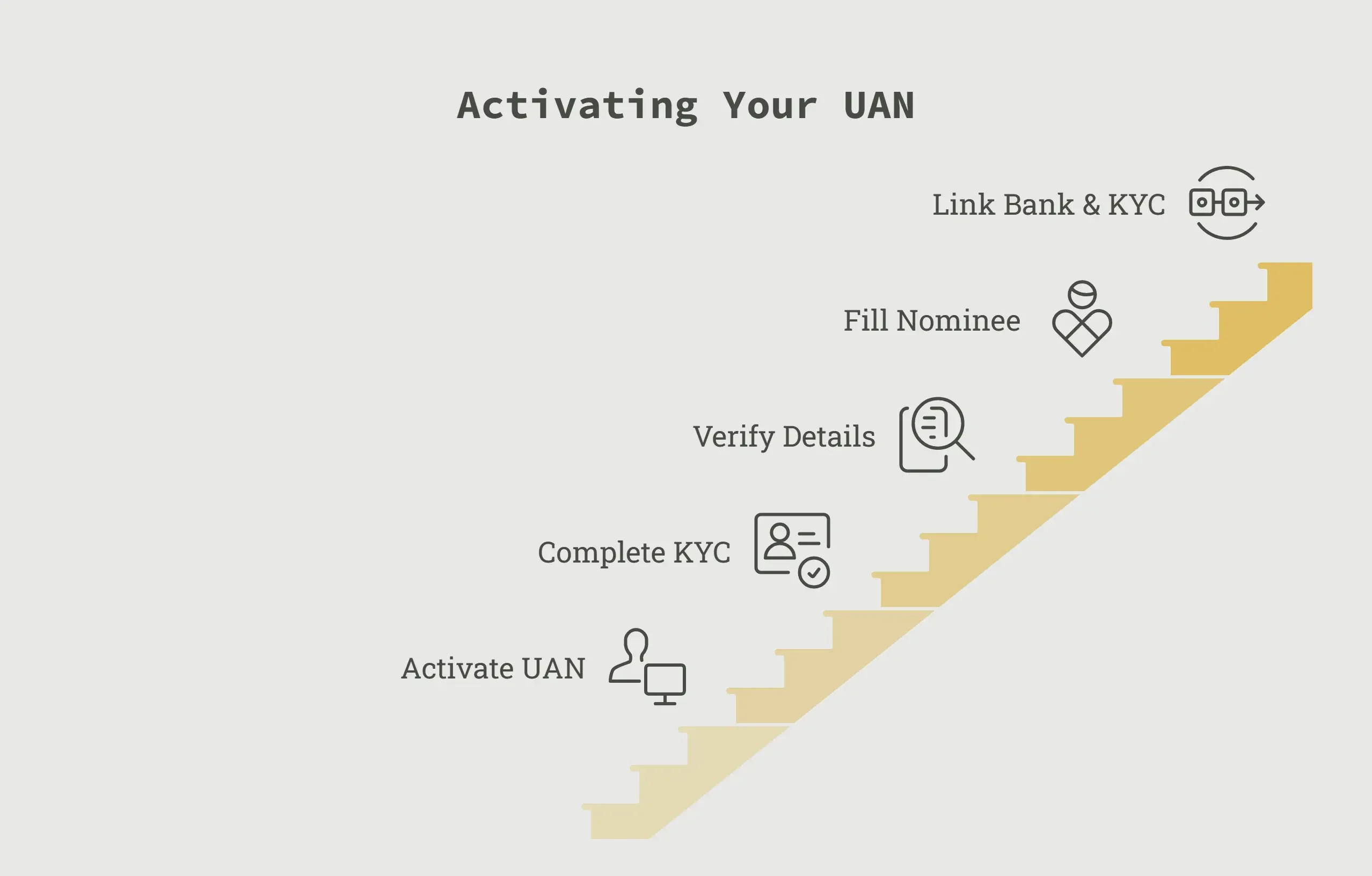
The Universal Account Number (UAN) is a unique 12 digit number given to each PF member. It stays the same for life, even when you change jobs, and each new employer’s PF account gets linked under it.
A UAN only works well when it is activated and your details are complete. Before you rely on it for a claim or transfer, make sure these are in place:
- UAN activated on the EPFO member portal with a mobile number you still use.
- KYC details such as Aadhaar, PAN and bank account added and approved. If you want to understand why this step is required across finance, read our guide on why KYC is mandatory in India.
- Name, date of birth and date of joining matching your documents.
- Nominee details filled in.
Linking your UAN to your bank account and KYC records is the most common way to avoid delays at claim time.
How Do I Manage My EPFO Account Online?
You manage your PF through the EPFO member portal and its mobile app using your UAN. From there you can see your passbook, download statements, update personal details, raise transfer requests and file withdrawal claims.
If your only goal is to see how much is in the account, our step by step guide on how to check your PF balance online walks through the options. The routine below takes a few minutes and catches problems early.
- Log in to the member portal with your UAN and open your passbook.
- Match each month’s credit against your payslip for your own share and the employer share.
- Look for a missing month, a wrong amount or a gap after a job change.
- If something is off, first ask your employer’s HR or accounts team, then raise a grievance through the EPFO channels on the portal.
Doing this twice a year is usually enough. A missing contribution is far easier to fix within months than years later.
How Is PF Interest Calculated?
EPFO declares an interest rate for each financial year, and interest is calculated on your monthly running balance and credited to your account after the year ends. Because the rate is declared yearly, the number you earn can differ from one year to the next. The rate for the current year is published on the EPFO member portal and in official announcements, which you can follow on the Press Information Bureau website.
PF interest compounds, which means interest earns further interest in later years. Compounding is the main reason leaving PF untouched for decades can produce a large balance, and the main reason an early withdrawal costs more than the amount you take out.
Can I Withdraw PF Before Retirement?
Yes, but only for specific reasons and within limits. The permitted purposes, the percentage you can take, the minimum service period and the paperwork are set by EPFO and change from time to time, so read them on the member portal before you apply.
| Option | What you receive | What it can cost you |
|---|---|---|
| Leave the PF untouched | Nothing now | You keep your full balance compounding for retirement |
| Partial withdrawal (advance) | A portion of the balance for an allowed purpose | Lower balance and lower future interest on the amount taken |
| Full withdrawal after leaving a job | The whole eligible balance | Loss of long term compounding, and possible tax if the service period is short |
| Transfer to the new employer’s account | Nothing now | Little, but the claim must be filed and tracked |
If you change jobs, transferring your old PF to the new account usually keeps the savings and the service record together. Withdrawing at every job change leaves you starting from zero each time.
Tax rules on PF withdrawal depend on factors such as your years of service and the amount. Read the current treatment on the Income Tax Department website before you claim.
Should I Use My PF to Pay Off Credit Card Debt?
Sometimes the answer is yes, but it is a trade off and not a default. PF money is meant for retirement, and what you take out stops compounding. Credit card debt, on the other hand, can cost a very high rate of interest, and that cost keeps growing while the balance stays unpaid.
Here is an illustrative comparison. It assumes Rs 50,000 of unpaid card balance charged at 40% a year, and it uses simple interest to keep the arithmetic easy. Your card’s actual rate is printed on your statement, and card billing and interest rules are set out in the Reserve Bank of India Master Direction on credit and debit cards.
| Step | Calculation | Result |
|---|---|---|
| Yearly interest on the card balance | 40% of Rs 50,000 | Rs 20,000 |
| Monthly interest, approximate | Rs 20,000 divided by 12 | About Rs 1,667 |
| Interest over 6 months if unpaid | Rs 1,667 x 6 | About Rs 10,000 |
| PF taken out to clear the card | Full balance | Rs 50,000 less in your retirement account |
In this example, leaving the card unpaid for six months adds about Rs 10,000 in interest, while withdrawing Rs 50,000 from PF removes Rs 50,000 from your retirement savings and every rupee of interest it would have earned. Which loss is larger depends on your card rate, how fast you can repay, and how many years remain before you retire.
Before using PF, it helps to ask three things. Can you clear the debt from monthly income in a year or less? Will the withdrawal be taxed or reduce an amount you cannot rebuild? Would a structured repayment plan cost less than the interest you are paying now? Borrower education material from the Reserve Bank of India financial education site can help you think through these costs.
If your card balance is the problem, you can look at ways to restructure it before you dip into retirement savings. See how BillCut can convert card debt into structured EMIs, so you can compare the cost with a PF withdrawal.
What Else Can You Do to Get More From Your PF?
These habits cost nothing and protect your savings:
- Match your payslip with your passbook twice a year and raise any gap early.
- Keep your KYC, bank account and mobile number updated so claims do not stall.
- Transfer your PF when you change jobs instead of withdrawing it.
- Add a nominee so the money reaches the right person if something happens to you.
- Consider voluntary contributions only after you have an emergency fund, because PF money is hard to reach quickly.
PF is one part of a retirement plan, not the whole of it. If you want to add market linked investing next to it, our guide to how a SIP works with examples is a good place to start, and you can compare its risk with the steadier PF before you decide.
Who Should and Should Not Withdraw PF Early?
Early withdrawal is a decision about your own situation, and the lists below describe patterns, not advice.
Who may reasonably consider a withdrawal
- People facing a genuine medical emergency or a planned home purchase or education cost covered by EPFO’s permitted purposes.
- People who have been out of work for a long period and have no other source of funds.
- People whose high interest debt is growing faster than they can repay it, and who have first compared other repayment options.
Who should think twice
- People still early in their career, because more years of compounding are lost.
- People who can clear the debt from monthly income within a year.
- People who would use the money for a non essential purchase.
- People who have not yet read the current withdrawal and tax rules on the EPFO and Income Tax Department sites.
If you are unsure, speak to a qualified financial adviser. BillCut does not give personal investment advice.
What Should You Do If There Is a Problem With Your PF?
Start with your employer, because most issues, such as a missing contribution or a wrong date of joining, originate in the employer’s filing. If that does not work, use the grievance option on the EPFO member portal and keep a record of your reference number.
Problems with a bank or an NBFC, for example on a loan or a card, go to that lender first and then to the Reserve Bank of India’s complaint channels. PF issues are handled by EPFO and not by the Reserve Bank of India, so use the right channel for the right problem.
Frequently Asked Questions
-
Who is eligible for PF?
Most salaried employees at covered employers are eligible, depending on the employer’s size and your basic pay relative to a threshold set by EPFO. Ask your HR team or read the current rule on the EPFO member portal.
-
Can I withdraw PF before retirement?
Yes, for specific purposes such as a home purchase, a medical emergency or higher education, and within limits set by EPFO. Read the current purposes, limits and paperwork on the member portal before you apply.
-
How do I check my PF balance?
Log in to the EPFO member portal with your UAN and open your passbook, or use the EPFO mobile app. The balance and each month’s contributions are shown there.
-
What is a UAN?
The Universal Account Number (UAN) is a unique 12 digit number given to each PF member. It stays the same when you change jobs and links your PF accounts from different employers.
-
How is PF interest calculated?
EPFO declares a rate for each financial year, and interest is worked out on your monthly running balance and credited after the year ends. The declared rate is published on the EPFO member portal.
-
What is the difference between PF and EPFO?
PF is the savings account that holds your money, and EPFO is the organisation that manages it. You contribute to PF, and you deal with EPFO for claims, transfers and corrections.
-
What happens to my PF when I change jobs?
Your UAN stays the same and the new employer’s account is linked to it. You can usually transfer the old balance to the new account instead of withdrawing it.
-
Is PF money taxed when I withdraw it?
It depends on factors such as your years of service and the amount withdrawn. Read the current treatment on the Income Tax Department website before you file a claim.
-
Why is my employer’s PF contribution not showing in my passbook?
A delay can come from the employer filing late or from a mismatch in your details. Match your passbook with your payslip, ask your employer first, and then use the grievance option on the EPFO member portal.
-
Should I withdraw PF to repay credit card debt?
It depends on your card’s interest rate, how quickly you can repay from income and how many years remain before retirement. Compare the interest you are paying with the retirement savings you would lose before deciding.
Are you still struggling with higher rate of interests on your credit card debts? Cut your bills with BillCut Today!