
By BillCut
Last updated: 16 October 2026
NACH stands for National Automated Clearing House. It is the system banks use to move money automatically for repeat payments, such as a loan EMI leaving your account every month or a salary arriving in it. The NACH meaning that matters to a borrower is simple: once you sign a NACH mandate, your lender can collect each EMI on its due date without you doing anything.
This guide explains how a NACH mandate works, how NACH differs from the older ECS system, what a failed NACH debit can cost you, what the Reserve Bank of India’s rules say about those charges, and how to cancel or change a mandate safely.
What is the NACH meaning in banking?
NACH is a centralised clearing system run by the National Payments Corporation of India (NPCI). It handles high volume, repeat transactions between banks. It was introduced to bring the many regional ECS systems into one national platform with a single set of rules.
NACH works in two directions. NACH credit pushes money into many accounts at once, for example salaries, pensions, dividends or subsidies. NACH debit pulls money from your account for bills and repayments, for example loan EMIs, insurance premiums, mutual fund investments and utility bills.
For most borrowers, NACH means NACH debit. When you take a personal loan, a consumer durable loan or a two wheeler loan, the lender usually asks you to register a NACH mandate so the EMI is collected automatically.
How does a NACH mandate work?
A NACH mandate is a standing permission you give a company to debit your bank account, up to a stated amount, on a stated schedule. It is the instruction that makes auto-debit legal and traceable. Here is the usual sequence.
- You sign the mandate. This is either a physical form signed at the time of the loan, or an e-mandate authorised online through net banking, a debit card or Aadhaar based verification.
- Your bank registers it. The mandate is checked against your account details and signature, then registered with a Unique Mandate Reference Number, called the UMRN.
- The lender presents the debit. On each due date, the lender sends a debit request for the EMI amount through NACH.
- Your bank processes it. If the balance covers the amount, the EMI is debited and the loan account is updated.
- If the balance is short, the debit fails. The bank returns the request unpaid. Both the bank and the lender may then apply charges, which are covered below.
Two details on the mandate form are worth checking before you sign. The first is the maximum amount, which is often set higher than your EMI. The second is the end date. Some forms say “until cancelled”, which means the permission does not end on its own when the loan closes.
What is the NACH meaning on a bank statement?
A NACH entry on your bank statement is an automatic debit or credit processed through NACH. A debit entry usually shows “NACH”, “ACH DR” or a similar code, followed by the name of the company that collected the money and sometimes the UMRN.
If you see a NACH debit you do not recognise, match the name and UMRN against your active loans, insurance policies and investments. If it still does not match, contact your bank the same day and ask it to identify the mandate behind the debit.
What is the difference between ECS and NACH?
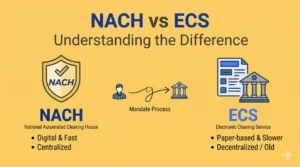
ECS, or Electronic Clearing Service, was the older auto-debit and auto-credit system. It ran through separate regional clearing centres, with more paperwork and slower mandate processing. NACH replaced ECS with one national platform, central mandate management and an online dispute system. Many people still say “ECS” when the debit actually runs on NACH.
The more useful comparison for a borrower is between the ways an EMI can leave your account today, because each one behaves differently when money is short or when you want to stop it.
| Payment method | Who starts each debit | How you stop it | What happens if your balance is short |
|---|---|---|---|
| NACH mandate | The lender, on each due date | Cancellation request to your bank, ideally after informing the lender | Debit fails, charges may apply, the EMI stays unpaid |
| ECS (legacy) | The lender, through older clearing centres | Written request to your bank | Same as NACH. Most ECS mandates have now moved to NACH |
| UPI AutoPay | The merchant or lender, as authorised in your UPI app | Pause or revoke from your UPI app | Debit fails, charges may apply |
| Standing instruction with your own bank | Your bank, on the schedule you set | Change or cancel it through your bank | Your bank may skip the payment and levy its own charge |
| Manual payment each month | You | Nothing to stop | No debit attempt, but a missed due date still counts as late |
What does a failed NACH debit cost?
A failed NACH debit can cost you twice: once in charges and once in the EMI that is still unpaid. Lenders usually levy a penal charge for the missed payment, and some banks also charge you for the returned debit. The amounts depend on your loan agreement and your bank’s schedule of charges, so the figures below are illustrative only.
| Illustrative item | Amount |
|---|---|
| Monthly EMI due | Rs 12,000 |
| Balance in account on the debit date | Rs 9,500 |
| Result | NACH debit fails, nothing is collected |
| Penal charge from the lender (illustrative) | Rs 500 |
| Return charge from your bank (illustrative) | Rs 300 |
| Total you pay to clear the month | Rs 12,800 |
In this example, a Rs 2,500 shortfall leads to Rs 800 in extra charges, which is about 6.7 percent of the EMI. The full Rs 12,000 EMI is still due, because a failed debit collects nothing, not even the Rs 9,500 that was in the account. If the shortfall repeats for three months, the illustrative charges alone reach Rs 2,400.
The bigger cost is often not the fee. An unpaid EMI that stays unpaid can be reported as overdue to credit bureaus, and how long it stays unpaid matters. BillCut explains this in detail in how a missed EMI compares with a few days’ delay on your credit score, and the fee side in why EMI bounce charges hurt more than they look.
If you are seeing more than one NACH debit fail because several EMIs fall in the same week, it may help to look at the total you owe rather than each debit on its own. BillCut can show you whether combining those dues into one structured EMI is an option for you. Check your options with BillCut.
What do RBI rules say about charges on a failed NACH debit?
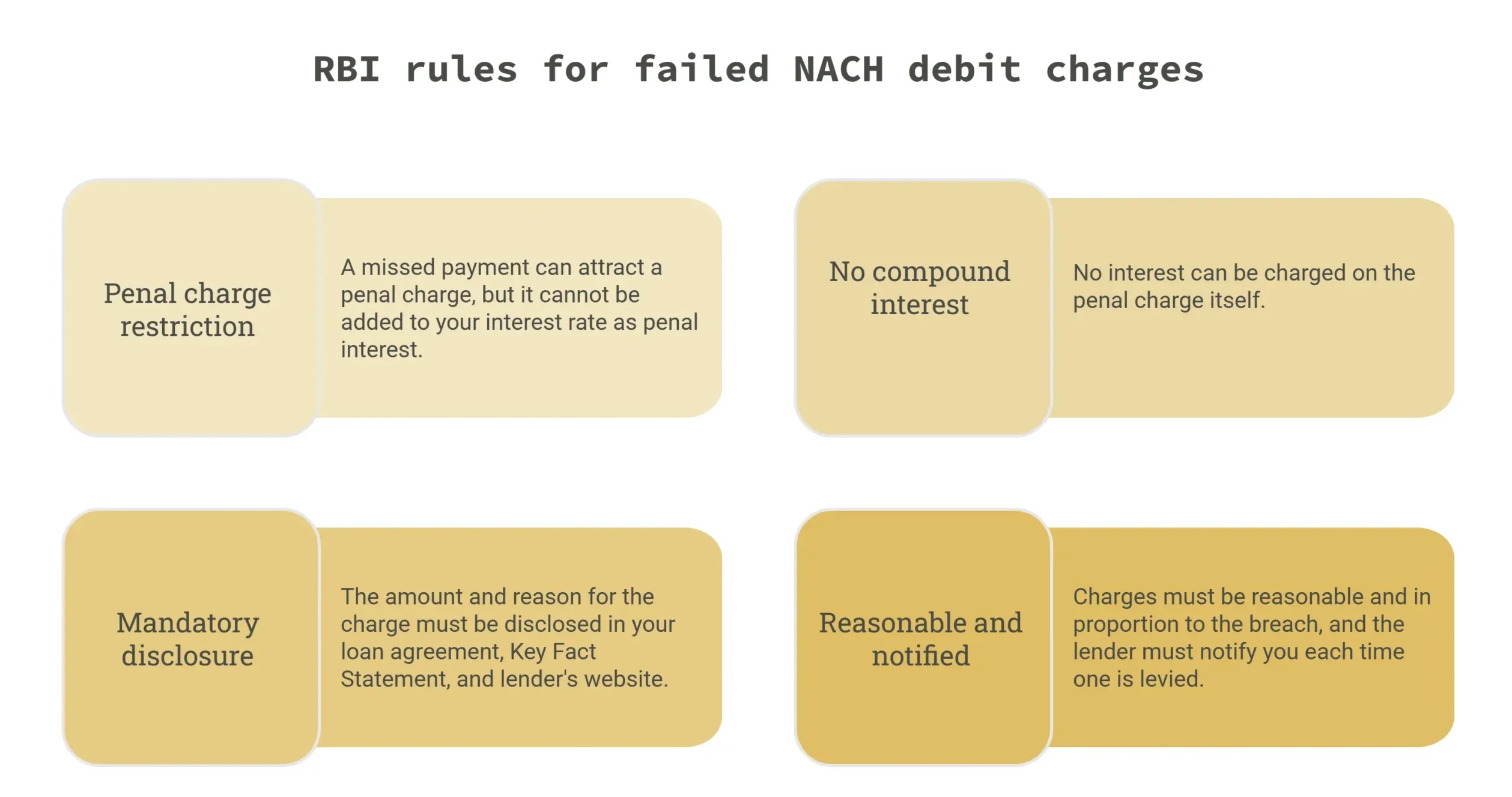
For loans from banks and NBFCs, the Reserve Bank of India’s circular on penal charges in loan accounts, which applies from 1 January 2024, sets the rules for what a lender can charge when you miss a payment. In plain terms:
- A missed payment can attract a penal charge, but it cannot be added to your interest rate as “penal interest”.
- No interest can be charged on the penal charge itself.
- The amount and the reason for the charge must be disclosed in your loan agreement and in the Key Fact Statement, the one-page summary of your loan’s cost, and on the lender’s website.
- Charges must be reasonable and in proportion to the breach, and each time one is levied the lender must tell you.
Two limits to keep in mind. This circular does not cover credit cards, which follow separate card rules. It also governs the lender’s charge, not the return charge your own bank may apply for a failed debit, which sits in your bank’s schedule of charges.
If your loan came through an app or website, the Reserve Bank of India (Digital Lending) Directions, 2025 require the lender to give you a Key Fact Statement. That document is the first place to check what a missed EMI will cost you.
Can you cancel a NACH mandate?
Yes. You can ask your bank to cancel a NACH mandate, usually through net banking, the bank’s app or a written request at your branch quoting the UMRN. Cancelling the mandate only withdraws permission to debit your account. It does not cancel the loan or change what you owe.
That distinction is where borrowers get into trouble. If you cancel the mandate while the loan is active and do not set up another way to pay, the next EMI is simply missed, with the charges and credit report effects that follow. If you want to move the EMI to a different account or date, ask the lender first and register the new mandate before cancelling the old one.
Cancellation is most useful in three situations:
- The loan is fully closed, but the mandate is still active.
- A debit is being presented for an amount or a company you did not authorise.
- The lender has agreed to switch your repayment to another account.
If money is debited after a valid cancellation, or a lender refuses to stop debits on a closed loan, first raise a written complaint with the lender and your bank. If it is not resolved, you can escalate to the Reserve Bank of India through its ombudsman and complaints system. You can also register a consumer grievance through the National Consumer Helpline, toll free on 1915.
What goes wrong with NACH mandates?
NACH is reliable as a system. Most problems come from timing, old mandates and amounts that do not match what you expected.
- Debit date before salary date. If the EMI is collected on the 1st and your salary arrives on the 5th, the debit can fail every month even though you can afford the EMI. BillCut covers this pattern in why auto-debit EMIs bounce.
- Several mandates on one account. When three or four EMIs are collected in the same few days, one debit can drain the balance and the next one fails.
- Mandates that outlive the loan. An “until cancelled” mandate on a closed loan can still be presented by mistake.
- A higher maximum amount than the EMI. The lender is expected to collect only what is due, but a high ceiling means you need to watch your statement.
- Re-presentation. Some lenders present a failed debit again a few days later, so the account can be hit with a second attempt and a second set of charges.
Who should and should not rely on NACH auto-debit?
NACH auto-debit suits you if your income arrives on a fixed date before the EMI date, you keep a buffer in the account, and you have one or two EMIs you can track easily. In that case it removes the risk of a forgotten payment, which is one of the most common reasons for a late mark.
It needs more care if your income is irregular, for example freelance, commission or seasonal work. It also needs care if several EMIs come out of the same account, or if your balance regularly runs close to zero before payday. In those cases, ask the lender to align the EMI date with your income date, keep a separate account just for EMIs, or pay manually a few days early.
NACH does not fix an EMI load that is larger than your income. If debits are failing because the total of your EMIs is too high, changing how they are collected will not change the outcome.
How can you avoid problems with NACH mandates?
- Note every active mandate on your account, with the lender name, amount, debit date and UMRN.
- Keep the EMI amount plus a small buffer in the account at least one day before each debit date.
- Ask your lender to move the EMI date closer to your salary date if the two do not line up.
- Read the penal charge and bounce charge lines in your Key Fact Statement before you sign.
- After you close a loan, ask the lender for a closure letter and confirm the mandate has been cancelled.
- Check your statement every month for NACH debits you do not recognise, and raise them with your bank the same day.
- If a debit fails, pay the EMI through the lender’s official channel as soon as you can, and keep the receipt.
How does BillCut help when NACH debits keep failing?
Repeated NACH failures are often a sign of an EMI calendar that no longer fits your income. A credit card bill, a personal loan and an app loan can each pull money on a different date, and one shortfall early in the month can set off failures across the rest.
BillCut is a debt refinancing platform. It works with lending partners to help eligible borrowers move high interest dues, such as credit card balances and loan EMIs, into one structured EMI with one due date. Fewer debits means fewer dates to manage and fewer chances for a single shortfall to trigger several sets of charges. BillCut covers this approach in more detail in how to stop juggling multiple loans.
BillCut earns from helping borrowers refinance, so it has an interest in this option. Refinancing is not right for everyone. Approval, rate and tenure depend on the partner lender’s assessment of your profile, and a longer tenure can mean paying more interest over the life of the loan. Compare the total cost before and after, not only the monthly EMI.
The bottom line
NACH is the system that collects your EMIs automatically, and a NACH mandate is the permission you sign to allow it. It replaced ECS and is now the default way loans are repaid in India. A mandate does not create debt and cancelling it does not end debt. What matters is the balance in your account on the debit date, the charges written into your loan documents, and whether your EMI dates still fit your income.
Frequently asked questions about NACH
What is the full form of NACH?
NACH stands for National Automated Clearing House. It is the system run by the National Payments Corporation of India that banks use to process repeat debits and credits such as EMIs, salaries and bill payments.
Are ECS and NACH the same thing?
No. NACH replaced the older ECS system with one national platform and central mandate management, although many banks and borrowers still use the word ECS for NACH debits.
What is the difference between NACH and e-NACH?
NACH is the clearing system, and e-NACH is a way of registering a NACH mandate online through net banking, a debit card or Aadhaar based verification instead of a signed paper form. The debit works the same way once the mandate is registered.
What is a UMRN in a NACH mandate?
UMRN stands for Unique Mandate Reference Number. It identifies your specific mandate, and your bank will usually ask for it when you want to modify or cancel the mandate.
Can I stop a NACH mandate while my loan is still active?
You can ask your bank to cancel it, but the loan and the EMI stay due. Unless you agree another payment method with the lender first, the next EMI will be missed and charges can apply.
How long does it take to cancel a NACH mandate?
There is no single fixed timeline, and a debit already being processed may still go through. Submit the request well before the next debit date and confirm with your bank that the status shows cancelled.
What happens if money is debited after I cancel a NACH mandate?
Raise a written complaint with your bank and the company that collected the money, and attach your cancellation acknowledgement. If it is not resolved, you can escalate to the Reserve Bank of India through its complaints system.
Is a NACH bounce charge the same as a penal charge?
Not always. The penal charge is levied by your lender under your loan agreement, while a return charge may be levied separately by your own bank, so one failed debit can lead to two charges.
Does a failed NACH debit affect my CIBIL score?
A failed debit is only a payment attempt, but the EMI it was meant to pay remains unpaid. If that EMI stays overdue, the lender can report it to credit bureaus, which can lower your credit score.
This article is for general information only and is not financial, legal or tax advice. Charges, rules and processes vary by lender and bank and can change. Check your loan agreement, Key Fact Statement and bank’s schedule of charges, and speak to a qualified professional before making decisions about your loans.
Are you still struggling with higher rate of interests on your credit card debts? Cut your bills with BillCut Today!