
By BillCut
Last updated: 16 October 2026
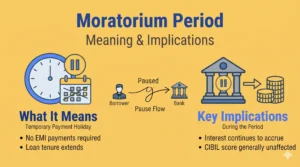
A moratorium period is a stretch of time during which you do not have to pay EMIs on a loan. The moratorium period meaning that matters most is this: it is a pause, not a waiver. Interest usually keeps building up during a moratorium, and you repay it later, either through a higher EMI or a longer loan.
This guide explains how a loan moratorium works, which loans come with one, how it differs from a grace period, what it costs in rupees, how it affects your credit score, and when it makes sense to ask for one.
What is the moratorium period meaning in a loan?
In a loan, a moratorium period is an agreed break from repayment. During this time, the lender does not expect EMIs, or expects only part of them, and does not treat the pause as a missed payment. Once the period ends, regular EMIs start again.
A moratorium can be built into the loan from the start, as with most education loans, or granted later by the lender when a borrower faces hardship. In both cases, the terms are set by the lender and should be written into your loan documents or a signed letter.
Two things are not a moratorium. Skipping EMIs without the lender’s written agreement is a default, not a pause. And a moratorium does not cancel interest. The only question is when and how that interest is paid.
How does a loan moratorium work?
Every lender sets its own terms, but most moratoriums follow the same pattern.
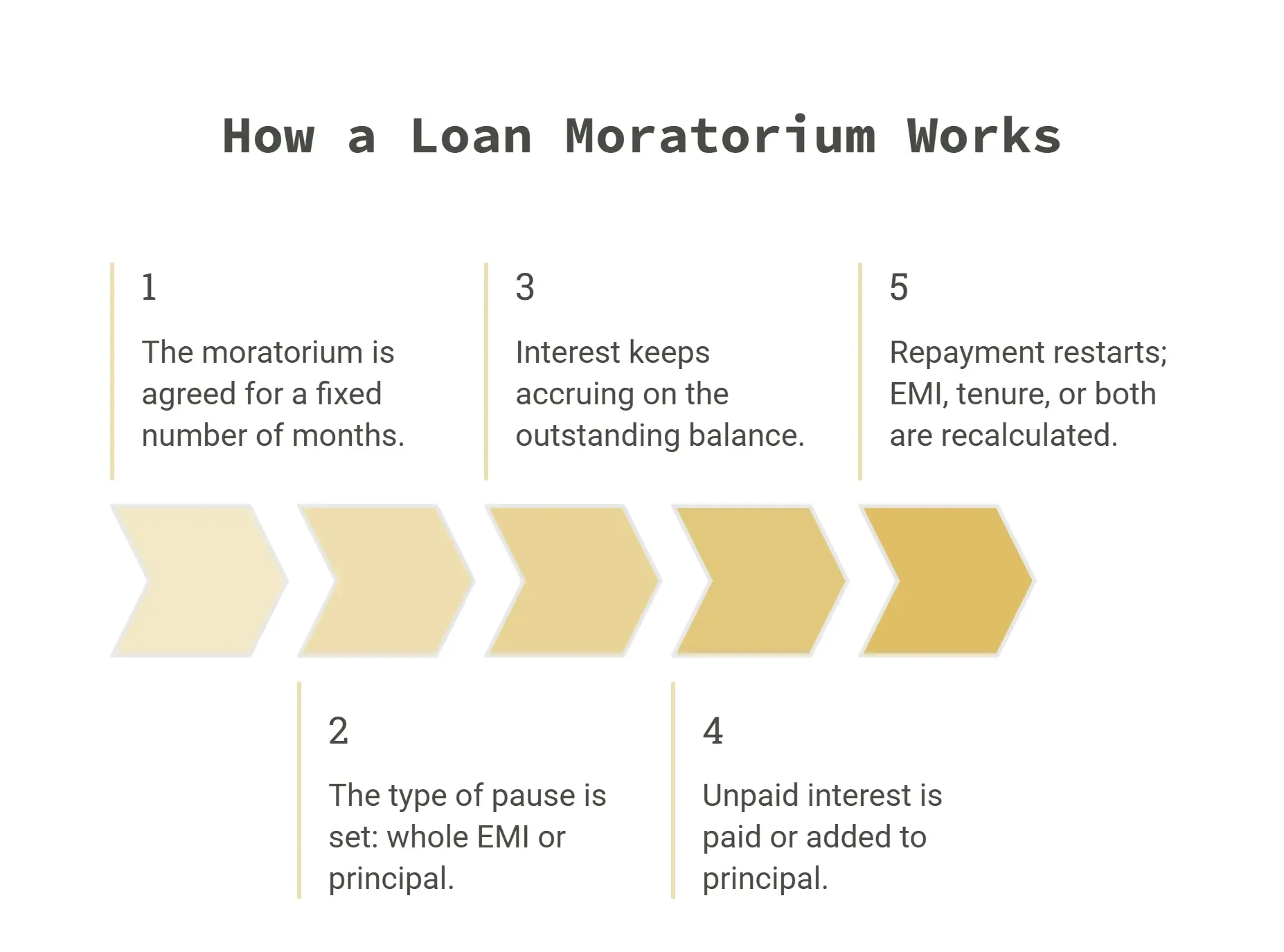
- The moratorium is agreed. It is either part of the original loan terms or approved by the lender on request, for a fixed number of months.
- The type of pause is set. Some moratoriums pause the whole EMI. Others pause only the principal, so you still pay the interest each month.
- Interest keeps accruing. Interest continues to be calculated on your outstanding balance throughout the moratorium.
- The unpaid interest is dealt with. At the end, the lender either asks you to pay the accrued interest or adds it to your outstanding principal, which is called capitalisation.
- Repayment restarts. The lender recalculates your EMI, extends the tenure, or does both, and regular EMIs begin again.
Which loans come with a moratorium period?
A moratorium is most common where the borrower is not expected to have income from the loan yet, or where a lender agrees to give short-term relief.
| Loan type | How the moratorium usually works |
|---|---|
| Education loan | Built in. Repayment typically starts after the course ends plus a further period set by the lender |
| Home loan for an under-construction property | Full EMIs often start after possession. You may pay interest only on the amount disbursed until then |
| Business or startup loan | Sometimes built in, to give the business time to generate cash flow |
| Personal loan or other retail loan | Not standard. Granted case by case, usually after a request backed by proof of hardship |
| Credit card | Not a moratorium in the usual sense. Unpaid dues keep attracting interest and charges |
If your loan comes with a built-in moratorium, read the sanction letter for three details: when the moratorium ends, whether interest is simple or compounded during it, and whether you can pay interest during the pause without a charge. Education loans and under-construction home loans often allow interest-only payments, which keeps the balance from growing. If your lender grants a moratorium later because of hardship, the terms are whatever its approval letter says, so ask for that letter before you stop paying.
Moratorium period meaning vs grace period: what is the difference?
A moratorium is a planned pause in EMIs that can last for months. A grace period is a short window after a due date, often a few days, during which a late payment may not attract a charge. Neither is the same as an EMI you simply skip.
| Feature | Moratorium period | Grace period | Skipped EMI without agreement |
|---|---|---|---|
| Length | Usually months | Usually days | Until you pay |
| Agreed by the lender | Yes, in writing | Yes, as part of the loan terms | No |
| Interest during the period | Usually keeps accruing | Keeps accruing | Keeps accruing, plus penal charges |
| Treated as a missed payment | No, if the terms are followed | No, if you pay within the window | Yes |
| Effect on future EMIs | Higher EMI or longer tenure | None | Arrears to clear, plus charges |
What does a loan moratorium actually cost?
A moratorium costs you the interest that builds up during the pause, and sometimes interest on that interest. The figures below are illustrative only. Actual rates and terms depend on your lender and loan.
| Illustrative loan | No moratorium | 6-month moratorium, interest added to principal | 6-month moratorium, interest paid monthly |
|---|---|---|---|
| Outstanding at the start | Rs 5,00,000 | Rs 5,00,000 | Rs 5,00,000 |
| Interest paid or added during the pause | None | Rs 30,000 added | Rs 5,000 a month, Rs 30,000 in total |
| EMI after the pause, 36 months at 12 percent a year | Rs 16,607 | Rs 17,604 | Rs 16,607 |
| Total repaid | Rs 5,97,858 | Rs 6,33,729 | Rs 6,27,858 |
| Extra cost compared with no moratorium | None | Rs 35,871 | Rs 30,000 |
In this example, six months of breathing room costs between Rs 30,000 and Rs 35,871. Adding the Rs 30,000 of accrued interest to the principal costs Rs 5,871 more than paying it monthly, because you then pay interest on the added amount for the rest of the loan. If you can afford the interest during the pause, paying it as you go is the cheaper version.
If a moratorium would only delay a problem, because several EMIs together are more than your income can carry, combining those dues into one structured EMI may be a more lasting fix. Check your options with BillCut.
Does a moratorium affect your CIBIL score?
A moratorium that your lender has agreed in writing is not a missed payment, so following its terms should not by itself count against you as a default. What does count is skipping EMIs without an agreement, or missing EMIs after the moratorium ends.
The weeks after a moratorium are the risky part. EMIs restart, sometimes at a higher amount, and a borrower who has not planned for that can miss the first one. BillCut explains how even a short delay can show up in how a missed EMI affects your credit score.
Some lenders may still note a moratorium or restructuring in their own records, and a future lender may ask about it. Keep the lender’s approval letter so you can show the pause was agreed.
What rules apply when a lender changes your repayment schedule?
A moratorium changes your repayment schedule, so the lender’s disclosure and conduct rules matter.
- Changes in terms. The Reserve Bank of India’s Fair Practices Code for NBFCs says NBFCs must give borrowers notice of changes in terms in a language they understand, and that changes in interest rates and charges should apply only going forward.
- Your loan documents. For loans taken through an app or website, the Reserve Bank of India (Digital Lending) Directions, 2025 require the lender to give you a Key Fact Statement. Compare it with the revised schedule after any moratorium.
- Charges after the pause. If you miss an EMI once repayment restarts, the Reserve Bank of India’s rules on penal charges in loan accounts say the penalty must be a disclosed charge, not extra interest, with no interest charged on it.
- Where to complain. If a lender charges you for an agreed moratorium or reports it wrongly, complain to the lender in writing first, then escalate through the Reserve Bank of India’s ombudsman and complaints system. You can also register a grievance with the National Consumer Helpline, toll free on 1915.
What are the risks of taking a loan moratorium?
- Higher total cost. As the example shows, you pay for the pause through accrued interest.
- A bigger EMI later. If the tenure stays the same, the EMI rises to cover the added interest.
- A longer loan. If the EMI stays the same, you stay in debt for longer.
- A false sense of relief. A moratorium buys time. It does not reduce what you owe, so it helps only if your income is likely to recover.
- Unclear terms. If the moratorium is agreed only on a call, there is nothing to rely on if the lender later reports missed EMIs.
Who should and should not take a moratorium?
A moratorium can make sense if your income has dropped for a short, defined period, for example between jobs with an offer in hand, during a medical recovery, or while waiting for a business payment, and you are confident you can repay in full once it ends.
It is usually a poor fit if your income is unlikely to recover soon, or if your total EMIs were already more than you could manage before the problem began. In those cases, a moratorium delays the shortfall and adds interest to it. Restructuring the loan over a longer tenure, or consolidating several dues into one EMI, may address the cause instead.
How do you ask your lender for a moratorium?
- Check your loan agreement to see whether a moratorium or EMI pause is already allowed.
- Contact the lender before you miss an EMI. A request made while the account is regular is easier to approve.
- Explain the reason in writing and attach proof, such as a termination letter, medical records or a delayed payment notice.
- Ask whether the moratorium covers the full EMI or only principal, and how accrued interest will be treated.
- Ask for the revised EMI, tenure and total amount payable, and compare them with your current schedule.
- Get the approval and the revised repayment schedule in writing before you stop paying.
- Set a reminder for the date EMIs restart, and keep the first EMI amount ready in your account.
Some lenders and apps now offer short, self-serve EMI pauses instead of a formal moratorium. BillCut explains how these work in how smart EMI pause features work.
How does BillCut help when a moratorium is not enough?
A moratorium helps when the problem is short-term. When the problem is that several EMIs and card bills together take more than your income can cover, pausing one loan for a few months rarely changes the outcome.
BillCut is a debt refinancing platform. It works with lending partners to help eligible borrowers move high interest dues, such as credit card balances and loan EMIs, into one structured EMI with one due date. BillCut covers this approach in how to stop juggling multiple loans.
BillCut earns from helping borrowers refinance, so it has an interest in this option. Refinancing is not right for everyone. Approval, rate and tenure depend on the partner lender’s assessment, and a longer tenure can mean more interest over the life of the loan. Compare the total cost of each option, not only the monthly EMI.
The bottom line
A moratorium period is an agreed pause in EMIs, not a discount on your loan. Interest keeps building up, and you pay for the break through a higher EMI, a longer tenure or both. It is a useful tool for a short, temporary drop in income, provided it is agreed in writing and you plan for the day EMIs restart. If the shortfall is long-term, look at options that change the size or structure of your debt instead.
Frequently asked questions about loan moratoriums
What is the moratorium period in simple words?
It is a break from paying EMIs that your lender agrees to, usually for a few months. Interest normally keeps building up during the break, and you repay it later.
Is interest charged during the moratorium period?
Usually yes. Interest keeps accruing on the outstanding balance, and it is either collected during the period or added to your principal when the moratorium ends.
What is the moratorium period in an education loan?
It is the period after you take an education loan when you do not have to repay, typically the length of the course plus some extra months set by the lender. Interest may still accrue during this time.
Can I pay EMIs during a moratorium?
In most cases, yes. Paying the interest, or part of the EMI, during the moratorium reduces the interest that gets added to your loan later.
Does a moratorium reduce my loan amount?
No. A moratorium only changes when you repay, not how much you owe, and the accrued interest usually increases the total.
Is a moratorium the same as an EMI holiday?
The terms are often used for the same thing, an agreed pause in EMIs. Check your lender’s letter to see exactly which payments are paused and how interest will be handled.
What happens when the moratorium period ends?
Regular EMIs restart, often at a higher amount or over a longer tenure to cover the accrued interest. Missing the first EMI after the moratorium counts as a missed payment.
Can a lender refuse a moratorium request?
Yes. Unless a moratorium is part of your loan terms, granting one is the lender’s decision based on your situation and repayment record.
Is a moratorium better than loan restructuring?
It depends on how long the problem will last. A moratorium suits a short income gap, while restructuring over a longer tenure may suit a longer drop in income.
This article is for general information only and is not financial, legal or tax advice. Moratorium terms, interest treatment and charges vary by lender and loan and can change. Check your loan agreement and any revised schedule carefully, and speak to a qualified professional before making decisions about your loans.
Are you still struggling with higher rate of interests on your credit card debts? Cut your bills with BillCut Today!