
By BillCut
Last updated: 17 October 2026
Loan consolidation is a good idea when a debt consolidation loan replaces expensive debts, such as credit card balances and app loans, with one loan at a lower interest rate that you repay over a similar or shorter period. It is a bad idea when it only lowers your EMI by stretching the tenure, when fees eat up the interest saving, or when you run the old cards up again.
This guide explains how loan consolidation works, what it costs in a worked example, how it affects your CIBIL score, the risks to watch for, and how to decide whether it fits your situation.
What is a debt consolidation loan?
A debt consolidation loan is a single new loan used to pay off several existing debts, so you are left with one lender, one EMI and one due date. It is usually an unsecured personal loan, although some borrowers use a secured loan such as a loan against property.
Loan consolidation does not reduce what you owe on the day you take it. It changes the price and shape of the debt. The saving, if there is one, comes from paying a lower interest rate on the same balance and from avoiding the late fees and penal charges that come with juggling many due dates.
It is different from debt settlement. Settlement closes a debt for less than you owe and marks your credit report as “settled”. Consolidation repays every old debt in full, so those accounts close normally.
How does a debt consolidation loan work?
The process is similar to taking any personal loan, with one extra step at the end: using the money to close the old debts.
- List every debt. Note each outstanding balance, interest rate, EMI and due date, including credit cards, personal loans, app loans and buy now pay later dues.
- Get a consolidation offer. The lender checks your income, existing EMIs and credit history, then offers an amount, rate and tenure.
- Compare total cost, not EMI. Add up the interest and fees under the new loan and compare them with what you would pay by continuing your current debts.
- Read the Key Fact Statement. Check the rate, processing fee, prepayment terms and penal charges before you sign.
- Pay off the old debts. Some lenders pay your old lenders directly. Otherwise, use the money to clear each balance in full the day it arrives.
- Close or freeze the old accounts. Get no dues certificates for the old loans, and decide which credit cards to close.
- Repay the new loan on time. Set up auto-debit for one EMI on a date just after your salary arrives.
Is loan consolidation a good idea? The numbers in one example
Whether consolidation saves money depends on three things: the rate on the new loan, the tenure you choose and the fees. The example below uses illustrative figures only. Real rates and fees depend on the lender and your profile.
Assume you owe Rs 2,50,000 across three debts: Rs 1,20,000 and Rs 60,000 on two credit cards at an illustrative 42 percent a year, and Rs 70,000 on an app loan at an illustrative 30 percent a year. You want to be debt free in 24 months.
| Option (illustrative) | Monthly payment | Total interest and fees | Time to debt free |
|---|---|---|---|
| Keep paying each debt at its own rate | Rs 15,123 | Rs 1,12,952 | 24 months |
| Consolidation loan at 16 percent, 24 months, Rs 5,000 fee | Rs 12,241 | Rs 48,779 | 24 months |
| Consolidation loan at 16 percent, stretched to 48 months, Rs 5,000 fee | Rs 7,085 | Rs 95,083 | 48 months |
Consolidating over the same 24 months cuts the monthly payment by Rs 2,882 and the total cost by Rs 64,173. Stretching the same loan to 48 months brings the EMI down to Rs 7,085, but costs Rs 46,304 more than the 24-month option and keeps you in debt for twice as long. It still costs Rs 17,869 less than doing nothing in this example, but only because the original rates are so high.
The lesson is that the lowest EMI is not the best deal. Choose the shortest tenure whose EMI you can pay every month without strain.
If you want to see what this comparison looks like with your own balances, BillCut can show you whether combining your dues into one structured EMI is an option. Check your options with BillCut.
When is loan consolidation a good idea?
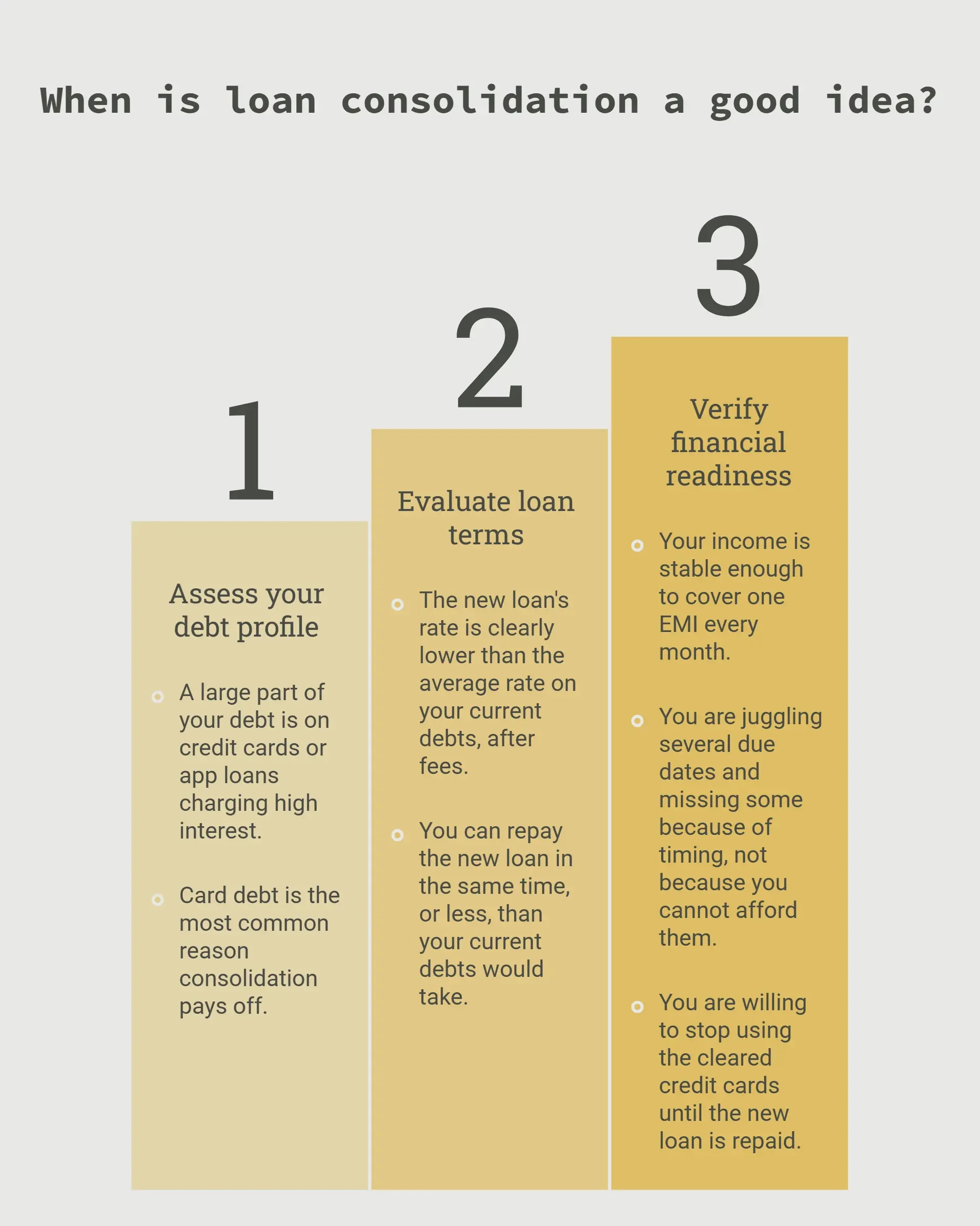
Consolidation tends to work when most of these are true:
- A large part of your debt is on credit cards or app loans charging high interest.
- The new loan’s rate is clearly lower than the average rate on your current debts, after fees.
- You can repay the new loan in the same time, or less, than your current debts would take.
- Your income is stable enough to cover one EMI every month.
- You are juggling several due dates and missing some because of timing, not because you cannot afford them.
- You are willing to stop using the cleared credit cards until the new loan is repaid.
Card debt is the most common reason consolidation pays off. Under the Reserve Bank of India’s Master Direction on credit and debit cards, the interest-free period on a card is suspended while any part of the previous bill remains unpaid. Carrying a balance means new purchases start attracting interest too. BillCut explains this in more detail in why paying only the minimum is never enough.
When is loan consolidation a bad idea?
Consolidation can leave you worse off in these situations:
- The rate is not much lower. If the new loan costs close to what you pay now, fees can wipe out the saving.
- You stretch the tenure a lot. A lower EMI over many more months can mean paying more interest in total.
- Most of your debt is already cheap. Moving a low-rate home loan or a no-cost EMI into a personal loan usually costs more.
- Your income is not enough for any EMI. If even one combined EMI is unaffordable, a new loan only delays the problem.
- The cards get used again. If the cleared cards are run up again, you end up with the new loan and new card debt.
- Your old loans carry heavy exit charges. Check the prepayment or foreclosure terms on each loan you plan to close.
Converting a single card bill into an EMI with the same issuer is a different, narrower option. BillCut compares it in whether you should convert a card bill to EMI.
Does a debt consolidation loan affect your CIBIL score?
A debt consolidation loan can lower your score slightly at first and help it over time. Applying adds a hard enquiry, and a new loan reduces the average age of your accounts. After that, paying off card balances lowers how much of your card limits you are using, and one EMI paid on time every month builds a steady repayment record.
Two things undo the benefit: missing EMIs on the new loan, and applying to many lenders in a short period, which adds several enquiries at once. Compare offers carefully, then apply where you are most likely to be approved.
What should you check before you sign?
A few rules and documents protect you when you take a consolidation loan.
- The Key Fact Statement. For loans taken through an app or website, the Reserve Bank of India (Digital Lending) Directions, 2025 require the lender to give you a Key Fact Statement, and any one-time processing fee charged if you exit during the cooling-off period must be disclosed upfront in it.
- Penal charges. The Reserve Bank of India’s rules on penal charges in loan accounts say a penalty for a missed EMI must be a disclosed charge, not extra interest, with no interest charged on it. Read the penal charge line before you sign.
- The lender itself. Before you share documents with an app offering consolidation, check that the lender is regulated using the Reserve Bank of India’s Sachet portal.
- Closing old cards. Under the same card Master Direction, an issuer must honour a closure request within seven working days once all dues are paid. Ask for written confirmation.
- Complaints. If a lender adds undisclosed charges or does not close an account you have paid off, complain to the lender in writing first, then escalate through the Reserve Bank of India’s ombudsman and complaints system.
Loan consolidation vs other ways out of debt
Consolidation is one of several routes. The comparison below focuses on outcomes rather than rates.
| Option | What you pay overall | What your credit report shows | Best suited to |
|---|---|---|---|
| Debt consolidation loan | The full amount, ideally at a lower rate | Old accounts closed in full, one new loan | Several high interest debts and a stable income |
| Card bill converted to EMI | The full amount at the card’s EMI rate | Card account active | One large card bill |
| Paying debts one by one, highest rate first | The full amount, no new loan | Accounts close as each is cleared | Borrowers who can pay more than the minimum on every debt |
| Restructuring with your lender | The full amount over a longer period | Account stays active | A temporary drop in income |
| Debt settlement | Less than the full amount | Settled | Long-term inability to repay in full |
Who should and should not consolidate?
Consolidation suits you if you have several high interest debts, a steady income that covers one EMI comfortably, and the discipline to leave the cleared cards unused. It also suits borrowers who keep missing payments because of too many due dates rather than too little money.
It is usually not the right step if your income has dropped sharply, if your debts are mostly low-rate secured loans, or if the only way to make the EMI affordable is a much longer tenure. In those cases, talk to your lenders about restructuring, or look at your total budget before taking on a new loan. BillCut’s guide on how to break the cycle of multiple EMIs covers the habits that help either way.
How to make loan consolidation work
- Write down every debt with its balance, rate, EMI and due date.
- Calculate the total you would pay by continuing as you are.
- Get two or three consolidation offers and compare total cost, including fees.
- Pick the shortest tenure whose EMI you can pay comfortably every month.
- Clear every old debt in full as soon as the loan money arrives, and collect no dues certificates.
- Close or lock the cleared credit cards, keeping only the oldest one if you need a card.
- Set the new EMI date just after your salary date and keep a small buffer in the account.
How does BillCut help with loan consolidation?
BillCut is a debt refinancing platform. It works with lending partners to help eligible borrowers move high interest dues, such as credit card balances and loan EMIs, into one structured EMI with one due date. The aim is the same as in the 24-month example above: a lower cost over a similar period, not just a smaller monthly payment.
BillCut earns from helping borrowers refinance, so it has an interest in this option. Consolidation is not right for everyone. Approval, rate and tenure depend on the partner lender’s assessment of your profile, and a longer tenure can mean more interest over the life of the loan. Compare the total cost before and after, and read the loan’s Key Fact Statement before you accept. For a broader look at the risks of refinancing apps, see whether debt refinancing apps are convenience or a trap.
The bottom line
Loan consolidation is a good idea when it replaces expensive debt with cheaper debt over a similar or shorter period, and when you stop the old debt from coming back. It is a poor idea when it only lowers the EMI by stretching the loan, when fees cancel the saving, or when income cannot support even one EMI. Judge every offer by its total cost and time to debt free, not by the monthly payment alone.
Frequently asked questions
Is loan consolidation a good idea?
It is a good idea when the new loan’s rate is clearly lower than your current debts and you repay it over a similar or shorter period. It is a poor idea if it only lowers your EMI by stretching the tenure.
Does debt consolidation hurt your CIBIL score?
It can dip slightly at first because of the new enquiry and the new account. Paying off card balances and then paying one EMI on time usually helps your score over time.
What are the disadvantages of a debt consolidation loan?
The main ones are fees, a longer tenure that raises total interest, and the risk of running up the cleared credit cards again. It also does not reduce the amount you owe on day one.
Can I consolidate credit card debt with a personal loan?
Yes. This is the most common use of a consolidation loan, because personal loan rates are often lower than the interest charged on a revolving card balance.
Is debt consolidation the same as debt settlement?
No. Consolidation repays every old debt in full with a new loan, while settlement closes a debt for less than you owe and is reported as settled on your credit report.
Will a consolidation loan reduce my EMI?
It usually does, either through a lower rate or a longer tenure. A lower EMI from a longer tenure can still mean paying more interest in total.
Can I consolidate loans from different banks and apps?
Yes. A consolidation loan can be used to repay loans and cards from different lenders, as long as each one is paid off in full.
Should I close my credit cards after consolidating?
Closing or locking the cleared cards removes the temptation to borrow again. If you keep one, keep the oldest card and pay its bill in full each month.
What do lenders check before giving a debt consolidation loan?
Lenders usually look at your income, existing EMIs, credit history and repayment record. Approval, rate and amount depend on each lender’s assessment.
This article is for general information only and is not financial, legal or tax advice. Interest rates, fees and eligibility vary by lender and can change, and all figures above are illustrative. Check your loan documents and Key Fact Statement carefully, and speak to a qualified professional before taking a new loan.
Are you still struggling with higher rate of interests on your credit card debts? Cut your bills with BillCut Today!